
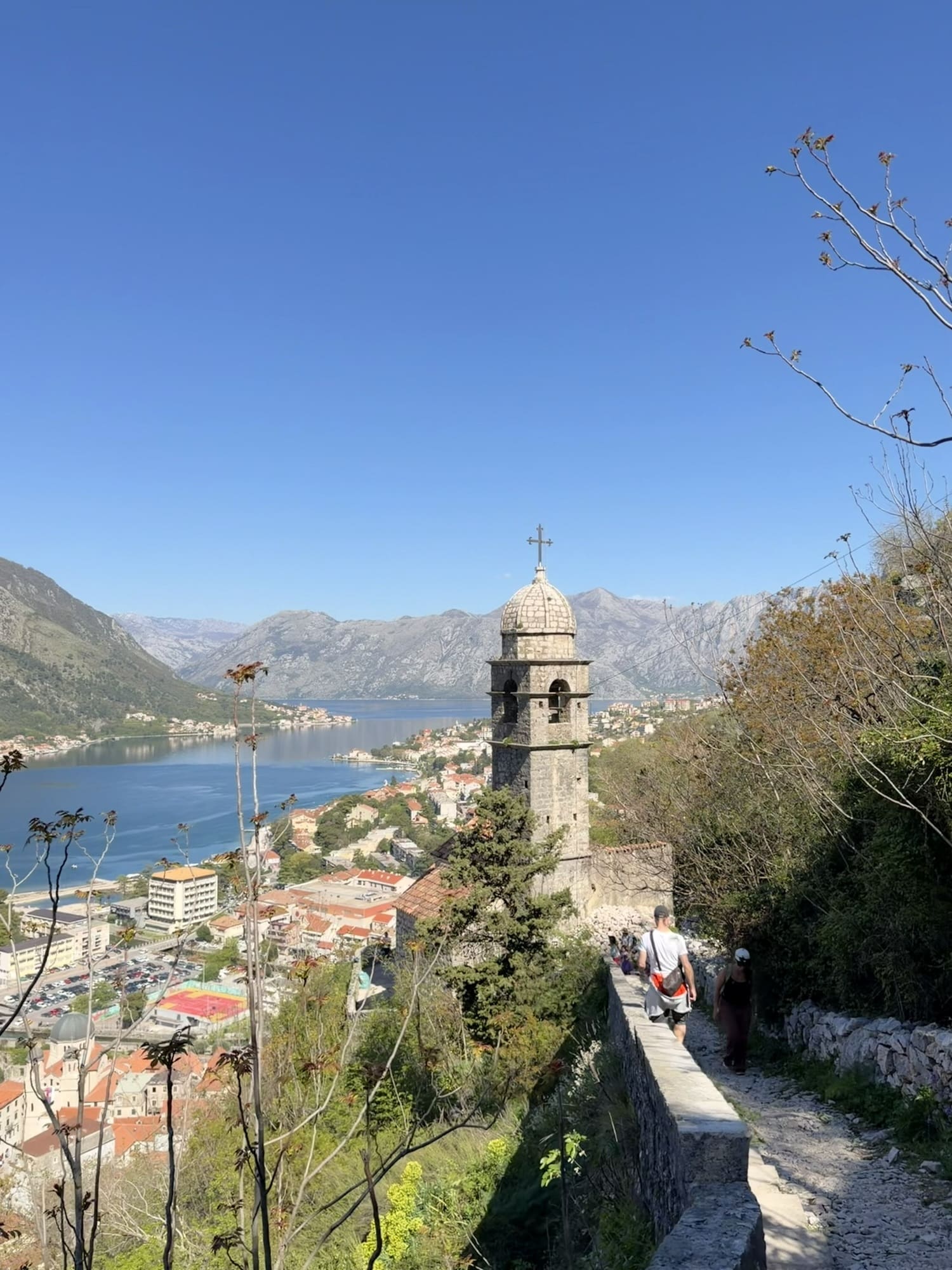

If you’re planning a trip to Montenegro, then I highly recommend adding Kotor and Perast to your itinerary. We drove from Dubrovnik to the Bay of Kotor and this area really exceeded our expectations.

One minute you’re wandering tiny cobbled lanes between ancient stone buildings; the next you’re looking out across the Bay of Kotor from high above the fortress walls with mountain views around you.
In this guide, I’m sharing the best things to do in Kotor and around the Bay of Kotor, including boat trips, the famous fortress hike, day trips to Perast, where to eat and a few honest tips we discovered along the way while travelling through Montenegro ourselves.

Contents
- Introduction to Kotor
- 1. Explore Kotor Old Town (Stari Grad)
- 2. Take a Free Walking Tour with GuruWalk
- 3. Hike up to San Giovanni Fortress
- 4. Walk the City Walls
- 5. Meet the Cats of Kotor
- 6. Take a Boat Trip on the Bay of Kotor
- 7. Day Trip to Perast
- 8. Take the Cable Car up to Mount Lovćen
- 9. Drink Wine Aged Underwater at Kraken
- 10. Eat and Drink Well
- Getting Around Kotor
- Best Time to Visit Kotor
- Practical Tips
Some of my content may contain affiliate links for companies I use and love and recommend to awesome readers like yourself. If you take action, (i.e. subscribe, make a purchase) after clicking one of these links, I’ll earn a small amount of pocket money (at no extra cost to you), so I can buy a coffee while creating more helpful content like this.
Introduction to Kotor
Tucked at the deepest point of the Bay of Kotor – among Europe’s southernmost fjord-like scenery – this is a historic town worth visiting. Dramatic limestone mountains rising almost vertically behind ancient walls, glittering water in front, and a characterful medieval Old Town.
Kotor is often compared to Dubrovnik, and yes, there are similarities (we visited both on this trip) – the Venetian architecture, the walled old town, the Adriatic setting. But despite being a popular tourist destination, Kotor is not quite as overrun as Dubrovnik, and it feels a little less touristic.
Whether you have one day or three, here’s everything you need to know about the best things to do in Kotor, Montenegro.

1. Explore Kotor Old Town (Stari Grad)
Kotor Old Town – Stari Grad – is a UNESCO World Heritage Site and, for good reason, one of the best-preserved medieval towns in the entire Mediterranean.
The history goes back over two thousand years: first a Roman settlement, then Byzantine, then famously Venetian for nearly four centuries from 1420 to 1797.
That long Venetian period shaped the architecture you see today – elegant stone palaces, ornate churches, and a labyrinth-like street plan that was designed to confuse invaders and still does a good job on first-time visitors. We found ourselves accidentally walking in circles!
Enter through the Sea Gate, the main entrance, and you’re immediately transported back in time. Narrow cobblestone lanes lead between tall stone buildings hung with laundry and window boxes. Hidden squares appear from nowhere. Cats sit in patches of sun as if they own the place (more on that shortly).

The big landmarks worth seeking out are: the Cathedral of Saint Tryphon, Kotor’s oldest and most impressive church, built in 1166, the Clock Tower in the main square, which has stood since 1602; and the Maritime Museum, housed in a baroque palace, which tells the story of Kotor’s centuries as a seafaring power.
We found the best thing to do in Kotor Old Town is to simply wander. Give yourself a morning with no agenda. The town is small enough that you won’t get seriously lost, and the things you stumble across are often the most memorable.
Tip: If you’re arriving in summer, get into the Old Town early. Cruise ships dock most days and by mid-morning the narrow streets fill up fast.

2. Take a Free Walking Tour with GuruWalk
Our favourite thing to do, whenever we visit a new city, is to take a walking tour with GuruWalk. This was one of the highlights of our visit and something I’d recommend to every independent traveller as a first activity.
Our guide was fantastic and her anecdotes about the history and modern life in Kotor made it really come to life. It gives you the kind of context that transforms a pretty medieval town into a place with real depth. The history of the cats, the legends behind the city gates, the stories behind the buildings.
GuruWalk has several Kotor tour options with local guides, departing at different times throughout the day. You don’t pay upfront – the tours run on a tip basis, so you pay what you feel it was worth at the end. In my experience, a good guide absolutely earns a decent tip.
The walking tours typically take around 90 minutes and cover the main Old Town highlights, but the best guides weave in local stories and humour that make it genuinely entertaining as well as informative.
Tip: Do a walking tour first, before the fortress hike. It put what you see into context.

3. Hike up to San Giovanni Fortress
This is one of the most popular things to do in Kotor. San Giovanni Fortress sits at the top of the medieval walls above the Old Town, and getting there involves climbing approximately 1,350 stone steps that snake up the mountainside. It sounds daunting, and it is pretty tough, but it’s absolutely worth it.
The views from the top are fantastic – the full sweep of the Bay of Kotor below, the red rooftops of the Old Town, the mountains rising on every side. On a clear day you can see for miles along the bay in both directions.
We climbed up in the morning before the heat. It is recommended to go before sunrise or at sunset but bring a torch because the ground is very uneven. When we did it, first thing in the morning, the light was beautiful and there were only a handful of people.
A few practical things to know:
- Wear proper shoes. The steps are steep and uneven in places.
- Take water. There’s nothing to buy on the way up but there was a lady selling drinks at the top.
- Go early – before the cruise ship crowds arrive if possible, and before the day heats up in summer. On our way down the cruise passengers had started to arrive and it was a lot busier.
- The entrance to the hike is through the Old Town walls; there’s an admission fee (around 15 Euros).
- Plan 1.5 to 2 hours for the round trip at a comfortable pace, more if you want time to sit at the top.

4. Walk the City Walls
The medieval walls of Kotor stretch around the Old Town and up the hillside to the fortress – in total around 4.5 kilometres of fortifications that took centuries to build and maintain.
We didn’t pay because it’s free before the busiest months. Walking sections of the walls at the lower level is included in the entrance ticket and gives you a completely different perspective on the Old Town: looking down into courtyards and squares that are invisible from street level.
One honest observation: We weren’t overly impressed – if you’re planning to both walk the walls and hike the fortress, do them together as part of the same morning, working your way up gradually. The walls themselves, as a standalone experience, are interesting but not spectacular – particularly if you’ve visited or are planning to visit Dubrovnik. Go in with the right expectations and you’ll enjoy them; go expecting Dubrovnik and you might be underwhelmed.

5. Meet the Cats of Kotor
Kotor is famous for its cats. There are thought to be thousands of them living in and around the Old Town, and they have been part of the city’s fabric for centuries. The story goes that sailors brought cats aboard their ships to keep the rodent population down, and over generations, Kotor’s feline population grew and flourished. Locals came to see them as a symbol of good luck – the unofficial mascot of the city.

Today the cats are everywhere. Sprawled on warm cobblestones, peering down from window ledges, tucking into bowls of food left out by shopkeepers and restaurant staff. There is a square near the Church of St. Mary – unofficially known as the Square of the Cats – where they gather to be fed. We went along to have a look and some children were enjoying cuddles but to be honest I found the smell of cat faeces a bit overwhelming!
If you’re a huge fan of cats, there is also the Cat Museum, a small two-room space filled with feline-themed artwork and photographs. Entry costs €1, and the proceeds go towards the care of Kotor’s stray cat population. I didn’t go inside myself but wandered through the area around it.

6. Take a Boat Trip on the Bay of Kotor
The Bay of Kotor is one of the most beautiful stretches of water in the Adriatic, and seeing it from the water is a completely different experience to viewing it from the shore. As we were staying in Perast, we took the boat trip from there but the the other passengers boarded at Kotor.
It was a small speedboat tour with only a handful of passengers. Stops included Our Lady of the Rocks – a tiny artificial island off the shore of Perast, with a beautiful baroque church, a former submarine tunnel, Mamula island – a luxury hotel that used to be a prison, and the Blue Cave, which is only accessible by boat.
Our Lady of the Rocks is one of the most photographed spots in Montenegro. According to legend, sailors from Perast built the island by gradually dropping rocks into the sea over centuries, adding to it every time they passed. The church on the island contains ex-votos left by sailors, paintings and silver tablets offered in thanks for safe returns.

The Blue Cave is the Bay’s other big attraction – a sea cave lit from below by filtered sunlight that turns the water a shade of turquoise. It’s reached by small boat.
You get to swim or snorkel in the water here but it was far too cold for me. One of our passengers jumped in and lasted a few minutes!
Most boat tours run half-day or full-day, and they’re reasonably priced given what’s included. Book in advance in peak season.
👉 Check availability and prices for Kotor speedboat tours.

7. Day Trip to Perast
If you have two or more days based around Kotor, Perast is a must. It’s a small Baroque village about 12 kilometres along the bay, with a waterfront lined with elegant old stone palaces and restaurants looking directly out across the water to Our Lady of the Rocks.
Perast is quieter and more relaxed than Kotor, with far fewer day-trippers. If you love churches, it has an extraordinary number for a town of its size – over a dozen – many of them in various states of romantic ruin.
The waterfront restaurants are excellent; sitting outside watching the bay in the evening is one of those slow, perfect travel moments.

There’s also a fab little wine tasting bar – Red and White Wine Bar, which offers wine flutes and pairings at very reasonable prices.
Montenegrin and Croatian wine is very impressive but not cheap!
We actually based ourselves in Perast rather than Kotor, which gave a very different experience to staying in the Old Town – quieter, more local, with Kotor as a day trip rather than a base. If you’re considering it, I’d recommend it. See our Perast hotel recommendations here.
Getting there: We hired a car for the wider trip but found the local bus between Kotor and Perast far easier for this particular route – you don’t have to think about parking, and the bay road is scenic enough that sitting back and watching it pass is no hardship.
Be aware that the buses are only once an hour. We found the bus routes slightly confusing but if you ask at the tourist office or your hotel – they are very helpful.

8. Take the Cable Car up to Mount Lovćen
This is a relatively new addition to Kotor’s offering – the Kotor-Lovćen cable car opened in 2023 – and it has quickly become one of the most talked-about things to do in Montenegro. The cable car departs from Dub station, about eight minutes drive from Kotor Old Town, and makes an 11-minute journey up to Mount Lovćen at 1,348 metres above sea level, with panoramic views of Kotor, Tivat, Perast and the whole bay opening up below.
At the top, as well as the views, there is now the VISA Alpine Coaster – Montenegro’s first – a mountain rollercoaster descent that costs around €8 on top of the cable car ticket and by all accounts is brilliant fun. Adult cable car tickets are around €20 return.
Sadly for us, the cable car wasn’t open when I visited, so I can’t give you a first-hand account. But my daughter’s partner went a couple of weeks after us and the photos he showed me were amazing. This is firmly on my list for next time, and from everything I’ve read and heard, it’s worth making time for.
Note: The cable car is seasonal – check ahead that it’s operating before you plan your day around it.
9. Drink Wine Aged Underwater at Kraken
This is Kotor’s most unusual experience, and one I’d put on my wish-list before our visit. Kraken is a floating wine bar on the Bay of Kotor, between Kotor and Perast, serving wines that have been aged at the bottom of the bay – 20 to 25 metres down – for a full year. The process uses the constant pressure, steady temperature and absence of light at depth to age the wine faster and differently than a traditional cellar. The bottles come up encrusted with coral and sea life, each one looking like it was retrieved from a shipwreck.
The wines include local Montenegrin varieties: Vranac (a bold red), Tamjanika (a white with citrus notes) and others. You can eat fresh seafood while you’re there – mussels, oysters, fish – and swim off the floating platform.
Reservations are essential, particularly in peak season, and the cost is around €100 for a bottle of wine and food. It’s a splurge, but there’s nothing else quite like it. Book well in advance through their Instagram (@underwater_wine_kotor) or website.

10. Eat and Drink Well
Kotor punches well above its weight for food. Here’s what I’d recommend:
Cathedral Pasta – we ate here and it was excellent. Good fresh pasta in the Old Town; exactly the kind of satisfying meal you want after a morning of walking and climbing.

Konoba Scala Santa – Recommended to me by our GuruWalk guide as the place locals actually eat. It’s a traditional Montenegrin konoba (tavern) sitting in a lovely cobblestone square in the Old Town. When I walked past, there were locals at every table. That’s always a good sign.
Primo Pizza – For a more relaxed, affordable option, Primo Pizza is popular with locals and visitors alike. Good, honest pizza without the tourist markup.
Kraken – see above.

And for something sweet: you must try a krempita before you leave Kotor. This is Kotor’s signature dessert – a custard slice made with three layers of puff pastry (rather than the usual two) sandwiching a thick, lightly sweetened vanilla cream, dusted with icing sugar.
Kotor’s version has its own name locally – kotorska pašta – and its own annual festival. It doesn’t look like much, but it tastes very yummy. Pick one up from a bakery or café; you’ll see them in windows all over the Old Town.

Getting Around Kotor
- On foot: The Old Town is entirely pedestrianised and small enough to walk across in 20 minutes. Everything in the historic centre is walkable.
- By bus: The local bus service along the bay is reliable and cheap. For Perast in particular, the bus is easier than driving – no parking stress, scenic journey, and very affordable. We had a hire car for the wider trip but used the bus back and forth between Kotor and Perast regularly.
- By bicycle: For the flat areas around the bay and along the waterfront, bicycle hire is a lovely way to explore at your own pace. Although the roads can be hair-raising. Several rental places operate near the Old Town.
- By water taxi: Water taxis run across the bay and are a fun way to get between certain points, though check routes and prices in advance.
- By car: Useful for wider Montenegro day trips – Perast, Budva, the cable car – but not necessary for Kotor itself. Parking near the Old Town can be difficult in high season.

Best Time to Visit Kotor
We visited in April, the weather for us was beautiful but it can be rainy in early Spring and not all the attractions are open.
May, June and September are the best months – warm enough to enjoy the bay and the outdoor restaurants, without the peak summer crowds and heat of July and August.
July and August are busy, expensive, and hot. Cruise ships arrive most days between Tuesday and Saturday, and by mid-morning the Old Town’s narrow streets feel very full. If you visit in peak summer, plan your Old Town exploring for early morning or evening.
October is cooler and quieter, with occasional rain, but perfectly pleasant if you don’t need guaranteed beach weather.
Practical Tips
- If you want to enter the aquarium, churches and museum – it’s worth purchasing the Kotor City Pass
- Currency: Montenegro uses the Euro, despite not being an EU member.
- Language: Montenegrin, (which is the same as Croatian and Serbian). English is widely spoken in tourist areas.
- Safety: Kotor is very safe. Standard precautions for petty theft apply, particularly around ATMs.
- Cruise ships: If you want the Old Town to yourself, go early. By 10am on cruise days, it’s a different experience.
- Fortress hike: Do this before Dubrovnik if you’re doing both – the views here are harder to beat.
- Kraken: Book in advance. Don’t leave it to chance.
- Oyster Farms: The Bay of Kotor is famous for its oysters – a must try in the area.

Kotor was one of the highlights of our Montenegro road trip and somewhere I’d happily return to. From wandering the medieval streets of the Old Town to boat trips across the bay and breathtaking views from the fortress, it completely exceeded our expectations.
Have you visited Kotor, or is it on your travel wish list? I’d love to hear your thoughts in the comments below.
And if you’re planning a trip to this beautiful part of the Adriatic, be sure to join my newsletter. I’ll be sharing more guides from Kotor, Perast and Dubrovnik, plus the practical tips, hidden gems and mistakes we learned from along the way.
Leave a Reply