
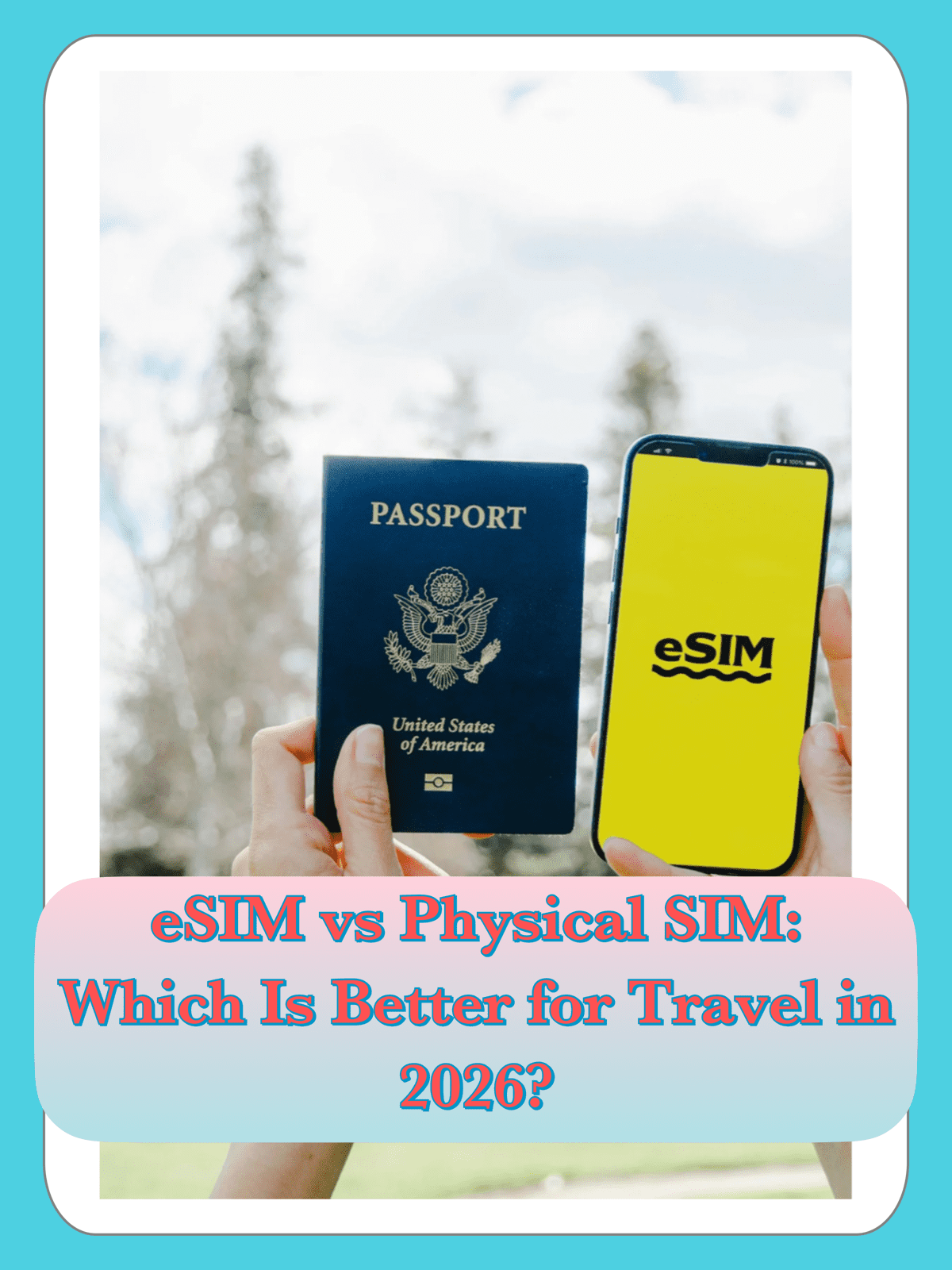

Staying connected when you travel is is easier than ever and essential. From finding your hotel using Google Maps or translating a sign, mobile data can make your trip smoother and far less stressful. But the question is which is better: an eSIM or a physical SIM?
If you’ve ever queued in an airport kiosk for a local SIM or felt nervous about swapping out your UK SIM and losing access to your WhatsApp, you’re not alone. The good news is that eSIMs have completely changed the game for travellers – but they’re not perfect for everyone.
In this guide, I’ll walk you through the differences between an eSIM and a physical SIM, explain how an eSIM works, and share my top recommendations for the best global eSIM, best Europe eSIM, and the best value options for short trips. I’ll also introduce you to Saily eSIM ahead of my full review.
Contents
- What Is an eSIM and How Does an eSIM Work?
- eSIM vs Physical SIM: What’s the Difference?
- When a Physical SIM Might Still Be the Better Option
- When an eSIM Is the Best Choice for Travel
- Do eSIMs Give You Calls and Texts Abroad? What Travellers Need to Know
- What About Physical SIM Cards? Do They Let You Receive Calls and Texts?
- Quick Summary for Travellers
- The Best eSIMs for Travel in 2026
- Spotlight: Saily eSIM (Full Review Coming Soon)
- How to Buy an eSIM and Set It Up Before You Travel
- Final Verdict: Which Is Better – an eSIM or a Physical SIM?
- Related Posts
Full Disclosure: Some of my content may contain affiliate links for companies I use and love and recommend to awesome readers like yourself. If you take action, (i.e. subscribe, make a purchase) after clicking one of these links, I’ll earn a small amount of pocket money (at no extra cost to you), so I can buy a coffee while creating more helpful content like this.

What Is an eSIM and How Does an eSIM Work?
An eSIM (embedded SIM) is a tiny digital version of the physical SIM card your phone normally uses. Instead of inserting a plastic card into your device, an eSIM can be activated with a QR code or an app.
How an eSIM Works in Simple Terms
- You choose an eSIM provider and data plan.
- You receive a QR code or activation instructions.
- You scan the QR code on your phone.
- Your phone downloads the mobile profile and connects to a local or global network.
- You can switch between your home SIM and travel eSIM at any time.
Essentially, buying an eSIM gives you instant access to mobile data without physically changing anything in your phone. If you’ve ever used Apple Pay or Google Wallet, the concept is similar – digital, instant, and incredibly convenient.
eSIM vs Physical SIM: What’s the Difference?
Both options will get you online, but the experience is very different. Here’s what you to know.
1. Convenience
- eSIM: Activate it from your sofa before you even leave the UK. No queues, no kiosks, no language barriers.
- Physical SIM: Requires finding a phone shop or airport kiosk, showing your passport (in some countries), and swapping SIM cards.
2. Cost
Physical SIMs used to be the cheapest option, but that gap is closing. Many eSIMs now offer competitive regional plans – especially in Europe and Asia.
3. Coverage
- eSIM: Amazing for multi-country trips because you can buy global or regional packages.
- Physical SIM: Often best for long stays in one country (e.g., digital nomads or expats).
4. Speed & Performance
Both offer fast speeds, but local physical SIMs sometimes have priority access over international eSIMs.
5. Flexibility
eSIMs let you switch providers instantly. Physical SIMs require you to physically replace the card, which can be annoying if you travel often. I always worry about misplacing my SIM card!
6. Compatibility
Not all phones support eSIMs. Most newer iPhones and Androids do, but older devices may not.

When a Physical SIM Might Still Be the Better Option
Although eSIMs are incredibly convenient, I’m not going to pretend they’re perfect for everyone.
A physical SIM might be better if:
- You’re visiting very remote destinations with poor eSIM coverage.
- Your phone doesn’t support eSIM technology.
- You’re staying long-term and want the cheapest local plan available.
- You prefer having a local phone number for reservations or deliveries.
When an eSIM Is the Best Choice for Travel
Most short-trip travellers – especially those heading away for up to two weeks – will find an eSIM easier and often better value.
An eSIM is ideal if:
- You’re travelling to multiple countries (especially in Europe).
- You want data as soon as the plane lands.
- You don’t want to remove your home SIM.
- You travel frequently and want a simple plug-and-play solution.
- You want to compare providers quickly for the best price.
Do eSIMs Give You Calls and Texts Abroad? What Travellers Need to Know
Most travel eSIMs are data-only, which means:
- You do NOT get a local phone number.
- You cannot receive normal calls or SMS texts through the eSIM.
- You can still use WhatsApp, iMessage, Facebook Messenger and similar apps for calling and messaging – because these run on data.
For most short holidays, data-only eSIMs are absolutely fine because nearly all travellers use WhatsApp or iMessage to communicate anyway.
What About Physical SIM Cards? Do They Let You Receive Calls and Texts?
If you buy a local physical SIM abroad:
- You get a new local phone number for that country.
- You can receive local calls and texts, which can be useful for reservations or tour operators.
- You can also make local calls cheaply.
However:
- Your UK number stops working while the physical SIM is inserted unless you have a dual-SIM phone and keep both active.
- Anyone calling or texting your UK number won’t reach you unless you still have your home SIM active or use Wi-Fi calling with certain networks.
Quick Summary for Travellers
Travel eSIM (data-only):
- No local number
- No standard calls/SMS
- Use WhatsApp/iMessage/Messenger instead
- Keep your UK SIM active for critical texts (bank codes, WhatsApp verification), but turn off data roaming to avoid charges
Physical local SIM:
- New local number
- Can make/receive local calls & SMS
- Your UK number won’t be active unless you have dual-SIM and keep both installed

The Best eSIMs for Travel in 2026
Here are some of the top-performing eSIM providers for easy, reliable travel data.
Best Global eSIM
Take a look at Airalo and Nomad.
Look for plans that offer coverage across 80-120+ countries. These are perfect for big trips, round-the-world adventures, or multi-stop holidays.
Top features to look for:
- Large global coverage zones
- Simple activation
- Clear fair-use policies
- Transparent pricing
Best Europe eSIM
👉 Check out Orange Holiday Europe and Holafly
If you’re heading on a multi-country European trip, a regional eSIM is cheaper and often faster than a global plan. These usually cover all EU countries plus popular extras like Norway, Switzerland and the UK.
Best Value-for-Money eSIMs
👉 Check out Saily, Airalo and Holafly
Some providers offer small packages (1-5GB) at very low prices – ideal if you only use data for maps and messaging.
Look for:
- Light data packages
- Short-duration plans (7-15 days)
- Rollover or top-up options
Best Unlimited Data eSIMs
Great if you plan to hotspot or stream, though always check their fair-use policy – “unlimited” often isn’t truly unlimited.
✨ Get a 5% discount when you purchase a Holafly eSIM (valid for new and existing customers and tops up!)
Spotlight: Saily eSIM (Full Review Coming Soon)
Saily eSIM is quickly becoming popular with travellers because it combines very straightforward pricing with reliable global coverage. It’s especially good for travellers who want a simple setup, a clean app, and affordable short-term plans.
My full review of Saily is coming soon, but here’s a quick snapshot of what makes it appealing:
- Easy to buy and activate from your phone
- Competitive rates for both Europe and global packages
- Works on most modern devices
- Ideal for holidaymakers and multi-country trips
- I like the way I get a discount code for friends and family
I’ve been testing Saily on my trips – stay tuned for the full breakdown.
In the meantime – if you’d like to try out Saily for yourself – you can get 10% off using my discount code: DIYTRAVEL10
👉Try out Saily and use my discount code
How to Buy an eSIM and Set It Up Before You Travel
The process is much simpler than most people expect. Here’s how to do it safely:
- Check your phone supports eSIMs.
- Make sure your phone is unlocked from your home network.
- Choose your preferred provider and data plan.
- Buy the eSIM and keep the QR code safe.
- Install it while connected to Wi-Fi.
- Switch it on once you arrive at your destination.
- Turn off data roaming on your UK SIM to avoid charges.
You can also keep your normal SIM active for calls and texts while using data from the eSIM – perfect for keeping WhatsApp, banking apps and two-factor authentication working.
Final Verdict: Which Is Better – an eSIM or a Physical SIM?
For most travellers – especially those going on short holidays, multi-country trips or Europe breaks – an eSIM for travel is the easiest, quickest, and most flexible option.
A physical SIM can still be cheaper in certain countries or for long stays, but the convenience of an eSIM is hard to beat.
If you’re ready to try one, start with a regional Europe plan or a best global eSIM package. And if you’re curious about Saily, don’t miss my upcoming review where I’ll test it in real-world travel conditions.
Make planning a trip yourself simple and stress-free with our ‘how to’ guides in the DIY Travel Planning Hub for tips on flights, accommodation, transport, itineraries and more – all in one place.
Leave a Reply